
Timed Hits List 002 – Promised Grace (Final Fantasy Crystal Chronicles)

Standard

I won’t even pretend that I’m not excited about Final Fantasy Crystal Chronicles Remastered. I’ve spent the majority of my spending money over the past year or so optimizing my audio/video setup for my Gamecube — the primary purpose being to play Crystal Chronicles with the highest fidelity possible. And now, on the cusp of making that dream a reality, it has all been rendered moot with the announcement of a Switch version. I’m not even a little bit mad; the more chances people get to play this tragically overlooked Final Fantasy the better. Especially if it means more people experiencing the soundtrack that proved Nobuo Uematsu wasn’t the only game in town.
Kumi Tanioka, who at this point in time was co-composer for Final Fantasy XI, masterfully scores the world of Crystal Chronicles with a band composed of traditional instruments from all over the world. We’re talking all kinds of lutes, recorders, bagpipes, crumhorns, and medieval instruments.
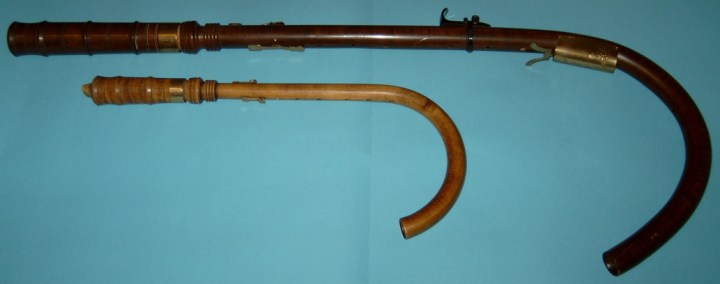
Moderne_Krummhoerner.jpg

Now that’s what I call a crumhorn!

There are ton of highlights in the Crystal Chronicles OST; Departure, the game’s first dungeon theme sets the melancholy tone of a world full of adventurers not seeking glory, but the means to keep their villages alive. Sad Monster and Unite, Descent provide a backdrop for an uneasy and wholly unique final boss battle. Tanioka even provides two different takes on Uematsu’s Moogle Theme from Final Fantasy V, Cripper Tripper Fritter. That melody won’t see that much love again until Masayoshi Soken’s Danny Elfman-inspired rendition in Final Fantasy XIV a decade later.

The track that I want to highlight today is from around the midway point of the main story – Promised Grace, the theme of Veo Lu Sluice.

One thing that really can’t be captured by listening to just the OST track is the stage introductions that accompany entering an area for the first time. Every level begins with a brief but outrageously charming monologue narrated by a northern English dialect that would make even the citiest of slickers yearn for the rolling emerald hills and grey skies of some kind of ‘–shire’. It also features one of the best sound design details in the series. Check out the video below to around the 1:30 mark:

Leaving only the barest of instrumentation during the spoken intro and then firing up the melody right as the stage name is introduced is such an excellent touch. Crystal Chronicles is also not a particularly lore-heavy game so these drip-fed bits of detail about the world (also the only part of the original release of Crystal Chronicles to be fully voiced) are a welcome moment of appreciation.

The song itself is just a blast. The instrumentation and Renaissance flair are reminiscent of Final Fantasy IX’s more traditional tunes — Rose of May meets Vamo alla Flamenco – but with a nuance that only Tanioka’s live band can provide. It’s not too much of a stretch to think that Final Fantasy IX character designer Toshiyuki Itahana’s involvement in the look of Crystal Chronicles could have influenced Tanioka in the same way it influenced Uematsu’s score for IX.

This really is one of the best examples in Crystal Chronicles of Tanioka’s commitment to a traditional sound. It’s not hard to imagine this playing in the background of any period film where everyone dances in a circle mid-high-five — I went to a Shakespeare festival or two; I know what’s up. In fact the return of Promised Grace’s melody is in nearly that exact kind of setting. Veo Lu Sluice’s theme returns in 2008’s spin-off of a spin-off, Final Fantasy Crystal Chronicles: The Crystal Bearers where it provides the music for one of the title’s several rhythm mini-games. Take a listen to it and some other further listening down below, including a piece from Tanioka’s beautiful stand-alone piano album, Sky’s The Limit and a piece from her iconic work on Final Fantasy XI.

Who knows if/when Tanioka will return to game composition but in the meantime she has left a unique footprint on the Final Fantasy series that deserves to be remembered fondly.

Further Listening:

Timed Hits List Review: SQUARE ENIX JAZZ -FINAL FANTASY-

Standard

The world of Final Fantasy arrange albums is as complex as the franchise itself; replete with nearly as many masterpieces-that-shouldn’t-be-missed as there are one-offs-that-you-could-probably-live-a-satisfying-life-never-experiencing. It’s not unreasonable for someone to see the dozens upon dozens of albums released in the past 20+ years and be intimidated enough to leave the whole darn thing alone. But for fans of Final Fantasy, fans of the music of Nobuo Uematsu and his successors, and those who are interested in videogame-adjacent music, there’s a lot to love if you’re willing to take the dive.

There’s no doubt that I’ll be covering many of these albums throughout the years but the first on the list is the most recent;

SQUARE ENIX JAZZ –FINAL FANTASY—

Released: November-22-2017

World-renowned jazz musicians, Eijiro Nakagawa and Ryu Kawamura have taken well-known tracks from nearly every game in the main series (sorry, fans of VII, XI, and XII) and infused them with the horns, swung rhythms, and improvised solos that make jazz what it is. But ‘jazz’ is a broad term and just slapping it onto some of the most memorable tunes in videogame history doesn’t necessarily mean instant success.

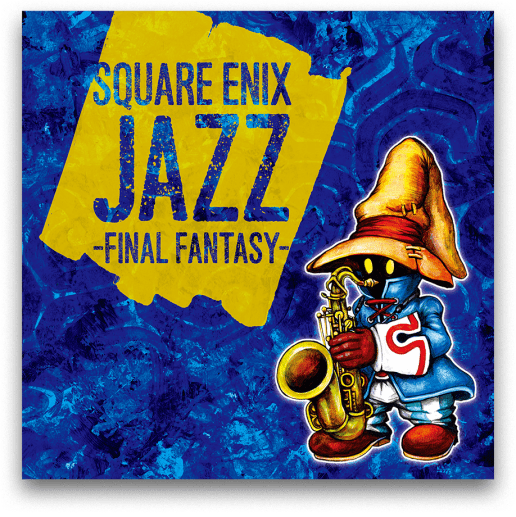
jacket.png

Before we even dive into this music I have a bone to pick. The history of jazz album art is as nuanced and beautiful as the music itself. It’s a history of high-contrast photography, energetic shapes and colours, high-impact fonts – it is mid-century graphic design at it’s absolute best. Maybe it’s too much to ask but SQUARE ENIX JAZZ –FINAL FANTASY- has easily one of the dorkiest covers I’ve seen in a long time, regardless of genre. Nothing to hang on the wall, that’s for sure. It’s too bad because Square has produced some excellent, if conceptually abstract, album art over the years. The cover features Vivi playing a saxophone over a blue background with the album title in a decidedly unattractive font in the top let corner. It’s criminally uninteresting. Nothing about this cover lets the listener know what they’re in for beyond the idea that Final Fantasy and ‘jazz’ are involved. It doesn’t take too long to discover that this lack of specificity and direction encompasses the style of (or lack thereof) jazz we’re about to experience.

The music starts off with a bang. A high energy, latin-infused rendition of Final Fantasy XIII’s “Blinded By Light” kicks things off and sets the stage for what we can expect from a lot of the tracks on this album; technically fantastic solo sections book-ended by well-trodden melodies. “Eternal Wind” from Final Fantasy III heads toward the more relaxed end of the spectrum but the instruments used give it an unfortunately “spa-waiting room” feel that rears it’s ugly head several times throughout the album. It’s unfortunate because “Eternal Wind” is one of my favourite songs in the series and I always look forward to a new arrangement of anything from FFIII. Luckily the melody is as infectious as ever and the drums and piano add interesting texture in the latter portions.

“Searching for Friends” from the tragically underappreciated Final Fantasy V falls into a similar trap as “Eternal Wind”; it’s a competent enough piece with excellent solos but the instruments chosen and the lack of contrast throughout the piece keeps it in the realm of background music. Final Fantasy IV’s famous “Battle With the Four Fiends” is the first track that feels at home. The bass is featured more prominently and the guitar takes a backseat to the tight shots from the horns. Everything backs off during the solos and gives the whole piece room to breathe, which is important when you’re fighting Golbez’s four best. Despite being a stressful song to listen to because of the memories tied to these moments in-game, this feels like one of the most fully realized pieces of music on the album.

Probably the most recognizable melody from Final Fantasy II, “The Rebel Army” takes the jazzier ideas from Four Fiends and runs with them; this tune gets swung to hell — where it kills the ruler of that fell place and returns even more powerful than before. Just bass, horns, piano, drums and backphrasing that won’t quit, this is one of the few tracks that would sit comfortable on anyone’s regular jazz playlist. It’s a genuine treat.

Kawamura’s call-and-response thru-line in Final Fantasy V’s “Clash on the Big Bridge” makes it a standout. This song goes plenty of fun places, none of which are expected from this boss fight theme. It builds to a fantastic battle between the piano and the sounds of the Super Famicom that culminates in Gilgamesh “running away” at the end. It suits the theme song for Final Fantasy’s most loveable villain.

“Serah’s Theme” from XIII is by far the most relaxing piece of the album and serves as an excellent intermission. Just some excellent jazz piano, a few bars of featured bass, the drums having a hell of a time, and one of Masashi Hamauzu’s finest melodies. This is another highlight that is bound to satisfy even those unfamiliar with Final Fantasy. X’s Zanarkand is a bona fide earworm. It seems a tad out of place with it’s Spanish guitar and oboe but it’s nice enough on it’s own.

The first of the back-to-back Final Fantasy IX tracks is the completely bonkers “Not Alone”. The original sounded very much like something you’d hear from a busker at the quay. This arrangement pays homage to that sound briefly and then proceeds to go all over the place. It brings in some New Orleans sound but drops it too soon. This song captures the feeling of the album almost perfectly: a lot of different components indicative of jazz that get abandoned too quickly to contribute to a theme. “Melodies of Life” is a lovely version of IX’s ending theme but it feels completely out of place. It’s a lovely ballad that unfortunately only adds to the confusion of what this album was trying to achieve. Certainly worth listening to if you’re a fan of that piece, but sticks out like a sore thumb.

“Love Grows” from Final Fantasy VIII is a sitcom theme song with a solo section. And it’s kind of great. Just imagining the cast of FFVIII in front of a studio audience is enough to sell this song for me. I don’t even care.

The album concludes with the tried and true “Final Fantasy Main Theme”. The wonderful solos are bookended by a guitar line that feels like a slap in the face. Though I suppose without a real theme for this album why NOT throw a rock ballad in at the end?

If the album’s goal was to create a Final Fantasy tribute that featured elements of jazz then I suppose it succeeded. Unfortunately it feels far too often like ‘jazz’ just happened to be a common denominator as opposed to the ethos of the arrangement process. Very rarely does this album explore interesting territory and when it does you’re bound to get a jarring return to “waiting room” jazz far too soon. Still, the handful of excellent tracks are worth listening to regardless of your familiarity with the source material. A lack of a cohesive thesis is what keeps the album as a whole from rising above it’s novelty.